The Growth Habit Most Founders Avoid: Getting Specific
The Growth Habit Most Founders Avoid: Getting Specific
Written by

Jaymi Onorato
Hey, I’m Jaymi.
I’m a founder and B2B growth marketer living in New York City with my lab mix, Millie. Outside of work, I’m a yogi, proud Italian (how did I JUST start watching the Sopranos?), and lover of all things soup.
I started my weekly newsletter, Growing, Going, Gone because I want to document what it’s like to build something while you’re still in the middle of it. Each iteration will be shown as a new post.
Not just the wins and successes but the growing pains, second-guessing, and decision-making most people don’t talk about.
This newsletter is for people building something of their own — especially founder-marketers — who care about growth but don’t want the highlight-reel version.

How this works
Each issue includes three parts:
Growing = what I’m learning and observing (ideas, systems, strategy)
Going = what I’m actively testing and trying right now
Gone = what I’m unlearning or letting go of (tools, beliefs, habits)
You’ll get candid, behind-the-scenes thinking: what worked, what flopped, and what I’m still unsure about.
Let’s get into it.
🌱 Growing
Micro > macro thinking
Last week, on my vacation in Antigua, I started reading The Cold Start Problem by Andrew Chen.
One story that stuck is how Uber used to run what they called a “war room.”
It’s a conference room for leadership to discuss issues like drops in metrics.
When something dipped, the question was never: Why is New York down?
They asked:
Where in New York?
Which borough?
What time of day?
Was there a major event?
Did a competitor roll out a driver incentive?
Did supply and demand fall out of balance?
They kept drilling into the data until they hit the root cause.
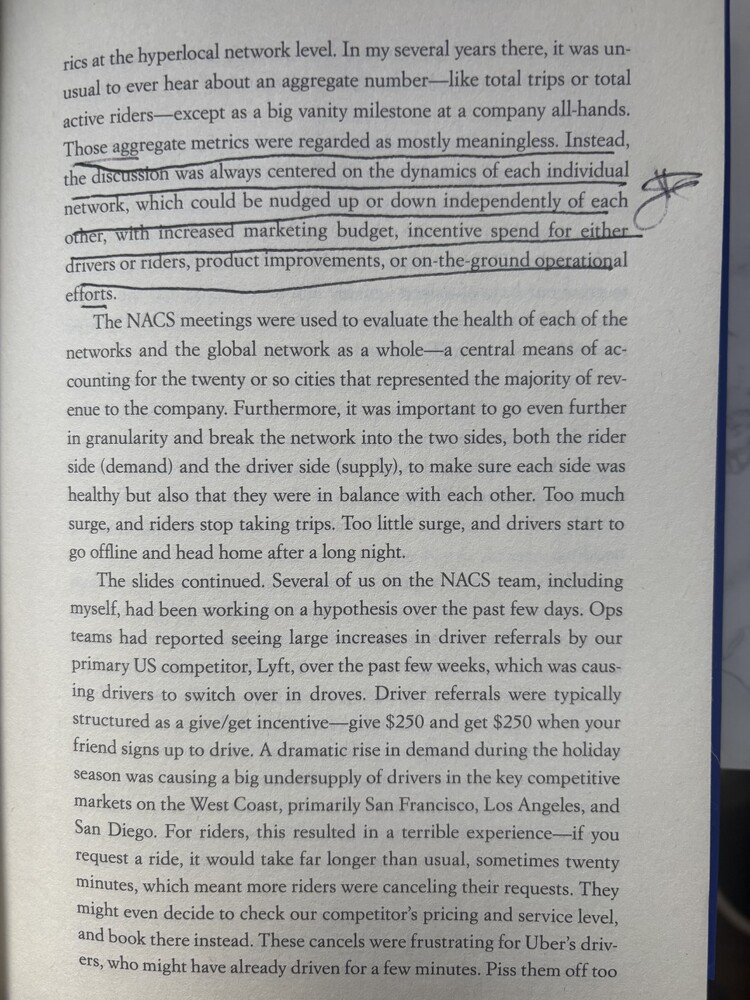
At Uber’s scale, vague answers can break systems fast.
But this mindset applies just as much to smaller teams and solo builders.
A lot of us are trained to think “big picture.” That’s not wrong.
But sometimes big-picture thinking becomes a way to avoid fixing the small thing we know is broken.
For me, this usually looks like:
I know what’s wrong
I know what to change
I just don’t feel like touching it
So I keep thinking about it… which somehow creates more stress than just fixing it. :D
Every time I finally make the change I’ve been procrastinating, there’s this huge sense of relief (I know we’ve all felt that in our work).
It’s easier to chase something new than to fix something old.
But growth doesn’t just come from big ideas…it comes from getting uncomfortably specific.
Sometimes, growth is missing a diagnosis— not creativity.
🏃🏻 Going
Probably doing too much, but at least I’m moving
Right now, my days are split across a lot of things: growth strategy for clients, website optimization for my own (always), content (hi newsletter!), evaluating tools to add to my tech stack, networking with other marketers and founders...
Some days when I know I did a LOT, I still can’t articulate what I did. The day just flew by.
So I ask myself:
Am I unfocused?
Am I doing too much?
Should I be more specialized by now?
Those are fair questions. But I keep coming back to this: Starting and learning is better than doubting and waiting (hard for us perfectionists, but worth doing).
That actually leads into something I want to go deeper on next week — Is it better to be a generalist or a specialist?
I asked Reddit and got 50+ responses. 👀
I’ll share some patterns in the next issue.
In the meantime, what do you think?
How I capture ideas without derailing my day
One super simple thing that’s helped me stay focused without losing ideas?
I text myself.
Ideas usually hit me in random moments, like when I’m walking Millie, on the train, in an elevator. Instead of switching tasks, I just send a quick text to myself and keep going.
At the end of the day, I sort them:
Website ideas → website change log
Things to read → inspiration list
Experiments → growth notes
By acting on ideas immediately, you don’t get anything done. It’s like starting a lot of things and finishing nothing.
Takeaway: Capture ideas in the moment, organize it all later, execute tomorrow (or scrap it).
✖️ Gone
Only relying on my own perspective
For a long time, most of my problem-solving happened entirely in my own head.
I’d analyze, rethink, second-guess — and assume I should already know the answer.
Late last year, I started pressure-testing those questions outside of myself: I started using Reddit.
It’s unfiltered, anonymous, and occasionally unhinged.
So I started using it not to copy answers, but to spot patterns.
I’ve asked things like:
What do you wish you did differently before starting a business?
What marketing trends will matter in 2026?
What assets actually convert clients?
To give you an example, here’s a common response I got for the last question on assets for converting clients (many people said similar things).
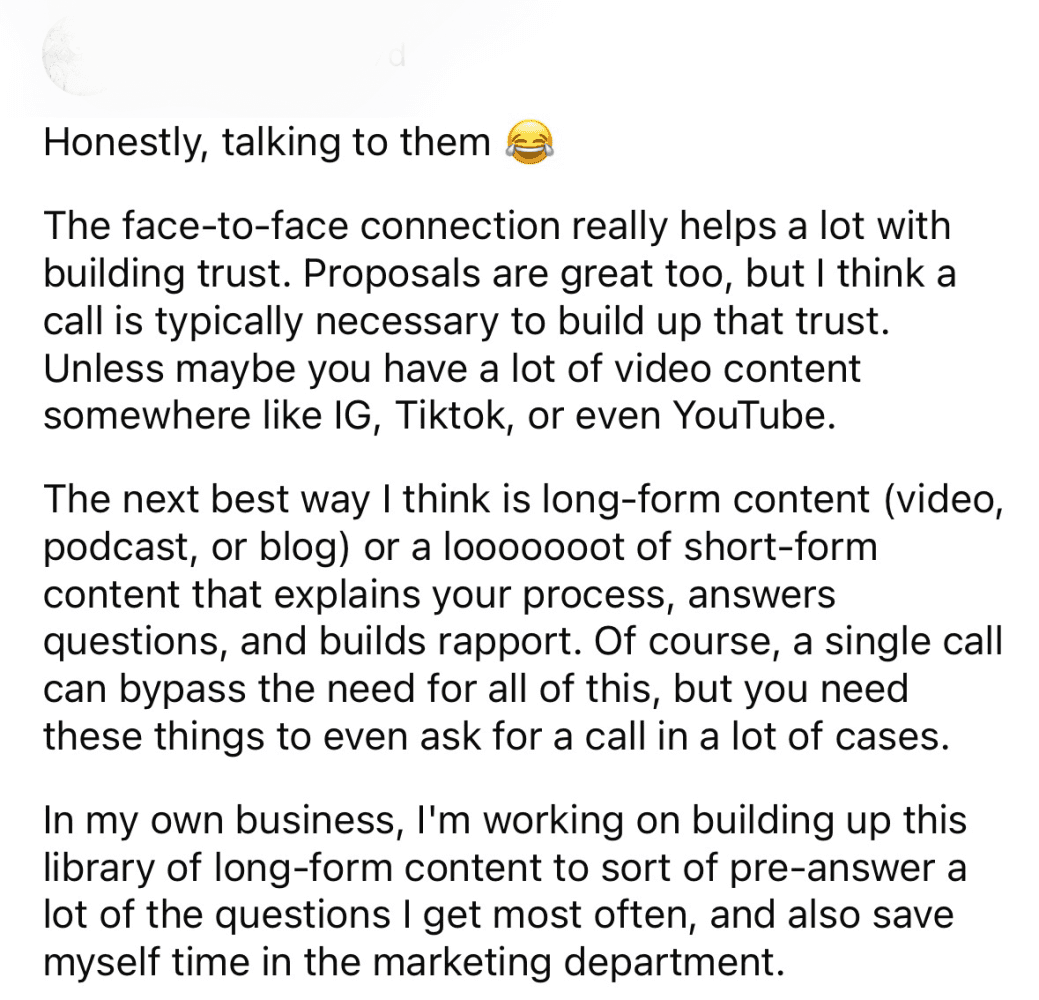
The value isn’t any single reply, it’s what patterns repeat.
How to use Reddit without getting lost in the sauce
Ask specific questions in niche communities
Look for patterns in responses, not hot takes
Ignore special cases
Synthesize on your own, don’t outsource thinking
But remember, you don’t want to focus too much on what others are saying or doing. In my experience, looking too much at what competitors/others do can sometimes steer you wrong. But this certainly helps spark inspo when you need it.
ALSO, know this: a lot of the “good” answers people get from tools like ChatGPT are actually shaped by the same kinds of conversations happening on reddit.
ChatGPT isn’t reading threads in real time. It uses info from these forums to understand real patterns in how people think, struggle, and solve problems.
Takeaways: Reddit shows you the raw signal. Tools like ChatGPT help recognize the pattern, but asking real people is still preferred.
🗽 Advice from a New Yorker
Each week, I'm asking someone in the city one question:
What’s one thing you’ve learned about building something?
This week’s answer came from Brittany, a messaging lead at Salesforce and marketer I look up to.
In my career I’ve built social media pages from scratch, reignited newsletters to up the engagement, and nurtured trust in communities I helped create. One thing I’ve learned about building is that people care deeply about AUTHENTICITY and SPECIFICITY. They want to know: 1) is this person/thing/service/information real? and 2) is this information profound enough to actually be applied in some way? Always go back to giving your audience a true reason to care, and keeping those values top of mind is a great start.

Until next time!
- Jaymi
Hey, I’m Jaymi.
I’m a founder and B2B growth marketer living in New York City with my lab mix, Millie. Outside of work, I’m a yogi, proud Italian (how did I JUST start watching the Sopranos?), and lover of all things soup.
I started my weekly newsletter, Growing, Going, Gone because I want to document what it’s like to build something while you’re still in the middle of it. Each iteration will be shown as a new post.
Not just the wins and successes but the growing pains, second-guessing, and decision-making most people don’t talk about.
This newsletter is for people building something of their own — especially founder-marketers — who care about growth but don’t want the highlight-reel version.
How this works
Each issue includes three parts:
Growing = what I’m learning and observing (ideas, systems, strategy)
Going = what I’m actively testing and trying right now
Gone = what I’m unlearning or letting go of (tools, beliefs, habits)
You’ll get candid, behind-the-scenes thinking: what worked, what flopped, and what I’m still unsure about.
Let’s get into it.
🌱 Growing
Micro > macro thinking
Last week, on my vacation in Antigua, I started reading The Cold Start Problem by Andrew Chen.
One story that stuck is how Uber used to run what they called a “war room.”
It’s a conference room for leadership to discuss issues like drops in metrics.
When something dipped, the question was never: Why is New York down?
They asked:
Where in New York?
Which borough?
What time of day?
Was there a major event?
Did a competitor roll out a driver incentive?
Did supply and demand fall out of balance?
They kept drilling into the data until they hit the root cause.
At Uber’s scale, vague answers can break systems fast.
But this mindset applies just as much to smaller teams and solo builders.
A lot of us are trained to think “big picture.” That’s not wrong.
But sometimes big-picture thinking becomes a way to avoid fixing the small thing we know is broken.
For me, this usually looks like:
I know what’s wrong
I know what to change
I just don’t feel like touching it
So I keep thinking about it… which somehow creates more stress than just fixing it. :D
Every time I finally make the change I’ve been procrastinating, there’s this huge sense of relief (I know we’ve all felt that in our work).
It’s easier to chase something new than to fix something old.
But growth doesn’t just come from big ideas…it comes from getting uncomfortably specific.
Sometimes, growth is missing a diagnosis— not creativity.
🏃🏻 Going
Probably doing too much, but at least I’m moving
Right now, my days are split across a lot of things: growth strategy for clients, website optimization for my own (always), content (hi newsletter!), evaluating tools to add to my tech stack, networking with other marketers and founders...
Some days when I know I did a LOT, I still can’t articulate what I did. The day just flew by.
So I ask myself:
Am I unfocused?
Am I doing too much?
Should I be more specialized by now?
Those are fair questions. But I keep coming back to this: Starting and learning is better than doubting and waiting (hard for us perfectionists, but worth doing).
That actually leads into something I want to go deeper on next week — Is it better to be a generalist or a specialist?
I asked Reddit and got 50+ responses. 👀
I’ll share some patterns in the next issue.
In the meantime, what do you think?
How I capture ideas without derailing my day
One super simple thing that’s helped me stay focused without losing ideas?
I text myself.
Ideas usually hit me in random moments, like when I’m walking Millie, on the train, in an elevator. Instead of switching tasks, I just send a quick text to myself and keep going.
At the end of the day, I sort them:
Website ideas → website change log
Things to read → inspiration list
Experiments → growth notes
By acting on ideas immediately, you don’t get anything done. It’s like starting a lot of things and finishing nothing.
Takeaway: Capture ideas in the moment, organize it all later, execute tomorrow (or scrap it).
✖️ Gone
Only relying on my own perspective
For a long time, most of my problem-solving happened entirely in my own head.
I’d analyze, rethink, second-guess — and assume I should already know the answer.
Late last year, I started pressure-testing those questions outside of myself: I started using Reddit.
It’s unfiltered, anonymous, and occasionally unhinged.
So I started using it not to copy answers, but to spot patterns.
I’ve asked things like:
What do you wish you did differently before starting a business?
What marketing trends will matter in 2026?
What assets actually convert clients?
To give you an example, here’s a common response I got for the last question on assets for converting clients (many people said similar things).
The value isn’t any single reply, it’s what patterns repeat.
How to use Reddit without getting lost in the sauce
Ask specific questions in niche communities
Look for patterns in responses, not hot takes
Ignore special cases
Synthesize on your own, don’t outsource thinking
But remember, you don’t want to focus too much on what others are saying or doing. In my experience, looking too much at what competitors/others do can sometimes steer you wrong. But this certainly helps spark inspo when you need it.
ALSO, know this: a lot of the “good” answers people get from tools like ChatGPT are actually shaped by the same kinds of conversations happening on reddit.
ChatGPT isn’t reading threads in real time. It uses info from these forums to understand real patterns in how people think, struggle, and solve problems.
Takeaways: Reddit shows you the raw signal. Tools like ChatGPT help recognize the pattern, but asking real people is still preferred.
🗽 Advice from a New Yorker
Each week, I'm asking someone in the city one question:
What’s one thing you’ve learned about building something?
This week’s answer came from Brittany, a messaging lead at Salesforce and marketer I look up to.
In my career I’ve built social media pages from scratch, reignited newsletters to up the engagement, and nurtured trust in communities I helped create. One thing I’ve learned about building is that people care deeply about AUTHENTICITY and SPECIFICITY. They want to know: 1) is this person/thing/service/information real? and 2) is this information profound enough to actually be applied in some way? Always go back to giving your audience a true reason to care, and keeping those values top of mind is a great start.
Until next time!
- Jaymi