When Should Marketing Show ROI?
When Should Marketing Show ROI?
Written by

Jaymi Onorato
Hey, it's Jaymi.
ROI has been on my mind as we close out Q1.
Return on investment is simple in theory: spend money, get more back.
But in B2B marketing, the investments are not small. They look like:
Paid media
Event sponsorships
Research reports
Intent data platforms
CRM systems and infrastructure
Attribution tools
Agencies and freelancers
Headcount
We can agree that the goal of any investment is to spend money to get more back. But when should we see that money come back? And how do you know something is working before revenue rolls in?
Two common misconceptions I've seen kill otherwise solid strategies:
Expecting short-term ROI from long-term investments
Expecting long-term payoff from short-term tactics (tactics are not the same as investments (I'll talk about this below)
The ROI conversation needs to happen before you spend, not after people start asking questions. If you're defining success mid-campaign, you're already behind.
🌱 Growing
ROI starts before you spend a dollar
Before you touch a single channel, you need to answer one question: what does marketing actually own?
Not "what campaigns are we running" > but what portion of revenue is our team responsible for influencing and/or driving directly? (Remember: marketing is increasingly becoming responsible for generating revenue, just like sales)
If you can't answer that, any ROI conversation becomes reactive rather than strategic. And being reactive is never really good.
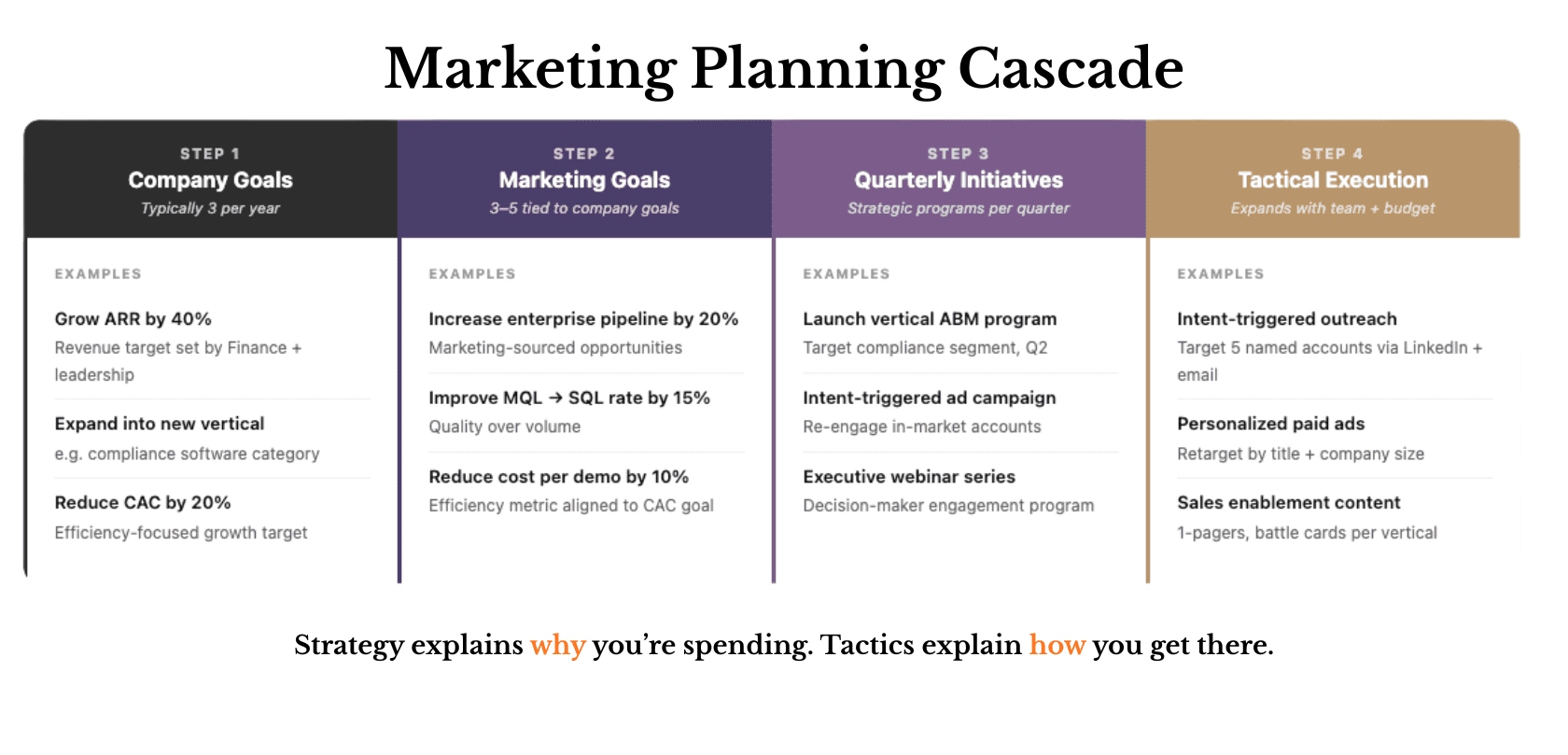
Step 1: Start with company-wide goals
Companies typically define a few overarching goals a year. They look like:
Acquire X customers in a new vertical
Drive $X in new revenue
Improve efficiency metrics (cost per demo, CAC)
Step 2: Define annual marketing goals
Strong annual marketing goals look like:
Increase MQL to opportunity conversion rate by X%
Improve demo-to-opportunity rate by X%
Reduce cost per demo while increasing volume
Increase marketing-sourced pipeline by X%
Strategy explains why you're spending. Tactics explain how you get there.
Step 3: Define marketing tactics to help you get there
Tactics look like:
Run industry-targeted LinkedIn ads
Launch 2 webinars/quarter
Go to 3 intimate networking events (C-level only)
Publish more blogs around new content pillars explaining company POV
Launch 1 new experimental channel
Tactics belong at the bottom of the cascade, not the top.
Strategy explains why you're spending. Tactics explain how you get there.
Running paid media is not a goal.
The goal is: generate qualified pipeline that converts to revenue. Paid is just a lever.
If your KPI is revenue but you're measuring impressions, then you're misaligned.
Impressions are up? Great. But:
Are the right people clicking?
Are they the right titles?
Are they converting to SQLs?
Are they progressing pipeline stages?
Not all investments pay back at the same speed.
This is the piece that creates the most friction between marketing and leadership, and it's almost never discussed upfront.
I've been in those rooms when tensions rise because leadership isn't seeing the return they expect.
The solution isn't finding a faster-converting tactic. It's setting the right expectations from the start.
Here's how I see it:
0–3 Month Signal Investments
These generate early indicators, not revenue-generating right away:
Paid search
Paid social
Retargeting
Outbound tied to ICP lists
Direct mail tied to open opportunities
Smaller field events
These are ways you start to get in front of the buyer.
Signal ≠ revenue. Signals look like:
MQL quality improving
MQL to SQL velocity increasing (more marketing leads accepted by sales as "good leads")
Demo show rate lifting
Increased reply rates
Accelerated pipeline progress
You want to optimize these in real time.
If after 2–3 optimization cycles you're seeing bad-fit leads, flat engagement, and no pipeline impact then pause, diagnose, cut if necessary.
But don't confuse "it didn't convert in 30 days" with "this doesn't work." Those are different conclusions with very different consequences.
3–6 Month Investments
These are meant to build momentum, not immediate return:
ABM programs (targeting one or a few accounts with concentrated resources, as opposed to marketing to your entire total addressable market)
Intent-driven advertising and content syndication
Co-branded content partnerships
Webinar series
Strategic event sponsorships
These should show named account engagement, pipeline acceleration, and opportunity conversion lift in this window.
Look, expecting closed-won revenue in 30 days misunderstands B2B buying cycles entirely.
The average enterprise deal takes 3–9+ months to close. Multiple stakeholders are involved: decision-maker, champion, influencer...each with different questions, timelines, and levels of urgency. You're not convincing one person. You're building the case for a committee, which takes time and repeated exposure before anyone is ready to take a meeting, let alone sign.
Realistically, it takes the average buyer 8-14 touch points for them to convert (hence why attribution is so incredibly important). You rarely run an ad and see a prospect become a customer the very next day.
Your audience isn't cold, they're just not ready yet. "Not ready yet" looks the same as "this doesn't work" if you're not tracking the right signals letting you know you're on the track.
Long-Term Compounding Investments (6–12+ Months)
These build authority and organic demand over time:
Research reports
Evergreen educational content
SEO
Brand positioning
Partnership ecosystems
You may not close a deal in 30 days from content you wrote in January. But over time, you'll see:
Inbound demand increasing
Direct traffic growing (direct = high intent when someone searches for you specifically)
Sales referencing your content on calls — watch any marketer light up when a sales rep mentions this
These assets compound and reduce future acquisition costs because you're building a demand generation engine that runs in the background. That's the long game.
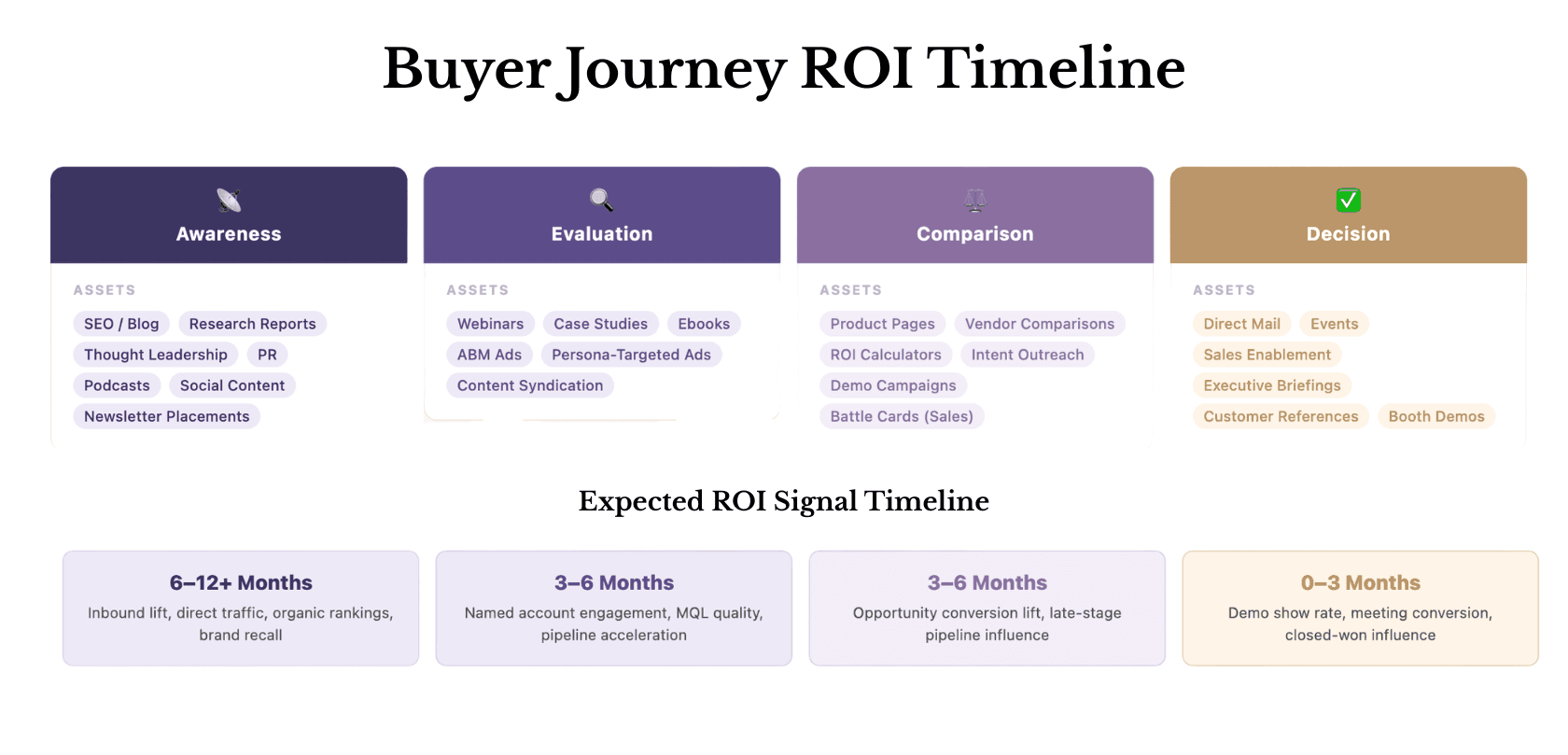
Note: Timelines shown are illustrative averages based on typical B2B buying cycles; actual results vary by industry, deal size, and sales cycle length.
The leadership conversation no one prepares you for
Early in my career, I worked with a founder who wanted to test newsletter sponsorships as a demand gen channel. The goal was to drive MQL volume with free trial offers.
What was expected to happen: quick conversions.
What actually happened: the audience wasn't warmed up enough to trust a free trial from a brand they'd seen once.
The instinct when that happens is to pull the investment. The smarter move is to look at what the data actually tells you.
After the first placement, we weren't converting. But we were building reach with the right titles in the right industries (always gauge the partner's audience to assess it's a good fit via demographic materials - don't partner if they can't provide this).
After the third and fourth placement, people who had now seen us multiple times started engaging — clicking through, requesting free trials, engaging with sales.
The tactic didn't fail. The timeline expectation was wrong.
What I've learned from rooms like that: if you don't define what "working" looks like before you spend, every conversation afterward becomes a defense instead of a data review.
Come in with a timeline framework: "in 0–3 months, here's what we should see. In 3–6 months, here's what we should see." That sets expectations and protects the investment from getting cut prematurely.
Intent data: where timing gets misunderstood
Intent platforms are expensive! Often mid-five figure annual investments. But there's a reason for this.
I spent time working at an intent data company serving enterprise clients and saw first-hand that when the data is accurate and your team can act on it fast, conversion rates are significantly higher.
The accounts that were in-market and received relevant, timely touch-points — matched to the exact topics they were already researching — converted much faster than generic outreach having no personalization. Speed and relevance matter more than volume.
Intent data allows you to:
Identify accounts actively researching relevant topics (you can track keywords around your business name, product category, competitor names)
Refine and prioritize your target account lists based on who's in-market now
Trigger personalized paid campaigns at the right moment
Support smarter, more timely sales outreach without seeming like you're blasting cold leads (sending relevant content, using the same keywords they were searching for)
The key word is timely.
Intent data is about right time, right place, right message. It tells you when an account is showing buying signals so you can act on their interest before it cools, without bombarding them with generic outreach that ignores what they've already told you through their behavior.
But intent data does not just work after you purchase it. It requires:
A defined monitored account universe
Clear intent thresholds (what signal level triggers action?)
CRM integration so sales can actually see and act on the data
A sales follow-up plan with defined SLAs
Without infrastructure, an intent-flagged lead can fall through the cracks entirely: a contact at a target account clicked a targeted ad, downloaded an ebook, and visited your pricing page....but sales has no idea any of it happened.
When structured correctly, you should expect pipeline lift in 3–6 months. Not 30 days.
If you're looking into intent data, make sure your team is operationally ready to use it.
Here's what that looks like.
Infrastructure: the hidden ROI driver
It may not be the sexiest topic on your mind, but it determines whether ROI is real or aspirational.
Infrastructure includes:
Account and lead source tagging (so you know where every lead came from)
Lifecycle stage tracking (so you know where every lead is in the funnel)
Demographic and firmographic enrichment
Proper lead scoring and routing rules
Defined sales SLAs for follow-up by tier
Sales enablement systems and assets that get used
On the flip side, broken infrastructure looks like: a contact at an intent-identified account clicks a targeted ad, downloads an ebook, and re-engages with your pricing page. But sales never gets flagged because the routing rule was never set up. The lead goes cold after a few weeks. The investment looks like it didn't work.
So, infrastructure doesn't generate demand. It prevents demand from leaking out the back.
Events: a different ROI equation entirely
My relationship with events runs deep from working at Worldwide Business Research, a company that organizes 20+ senior-level networking events a year, to being on the sponsoring and attending side in every B2B role since.
They can be your highest revenue driver or your most expensive branding exercise.
The difference is almost never what happens at the event. It's what happens before and after it.
Ways to participate:
Sponsor a booth
Buy a speaking slot
Host roundtables or invite-only networking events at the conference
Host a private dinner (entirely coordinated by your org, usually off-site)
Attend only, with scannable QR codes / badges other attendees can use to learn more
Before you commit budget, ask the organizer for:
Company breakdown of attendees (sometimes they'll show last year's full list, sometimes a sample of logos for the current year)
Job title and seniority breakdown
Industry and company size segmentation data
Past year attendance figures
Then reach out to target attendees before you get there — on LinkedIn, not just the conference app. The app feels transactional because everyone is doing it. LinkedIn feels organic because they've seen your profile and have context.
Before the event, prep your sales team properly. Give reps the conference floor plan, a breakdown of who's attending by title and company (plus highlight any current opportunities or clients on the list), any competitors showing up so they have differentiation points ready, and clear demo talking points.
At the event: lead scanners are non-negotiable. I repeat: non-negotiable.
You will talk to 50+ people in two days. By person 30, you will not remember what person 15 said, what their specific challenge was, or whether they asked for a follow-up.
A scanner with note fields solves that. Minimally, you want to capture: name, company, title, pain point mentioned, competitor they use (if applicable), interest level, and agreed-upon next step.
No scanner means no lead record. No lead record means no follow-up. No follow-up means you just paid sponsorship fees for a branding exercise.
For enterprise, booth demos are one of the most valuable things you can do.
When someone can see your product live with a subject matter expert right there to answer questions, that shortens the evaluation cycle significantly. Scheduling a demo three weeks later means competing with their calendar, their other priorities, and their fading memory of the conversation. That's a much harder close.
After the event is where your ROI lives. Most teams spend budget on just showing up. The ones who consistently win spend equal attention on what happens after they leave:
Tier your leads in the CRM within 48 hours: Tier 1 (ready now), Tier 2 (warm, 30-day follow-up), Tier 3 (longer-term nurture). Speed of follow-up by tier directly impacts conversion rate; the longer a warm lead sits un-contacted, the colder it gets
Upload scanner notes and tag them to the lead record — create a "Booth Notes - [Event Name]" field sales can see immediately when they pull up a contact in CRM
Follow up with something that references the conversation. Not "great meeting you at [event]!" but "you mentioned you were struggling with X - here's something that might be relevant."
The more specific your follow-up, the better it performs. Referencing what someone told you, by name, will always outperform a generic sequence
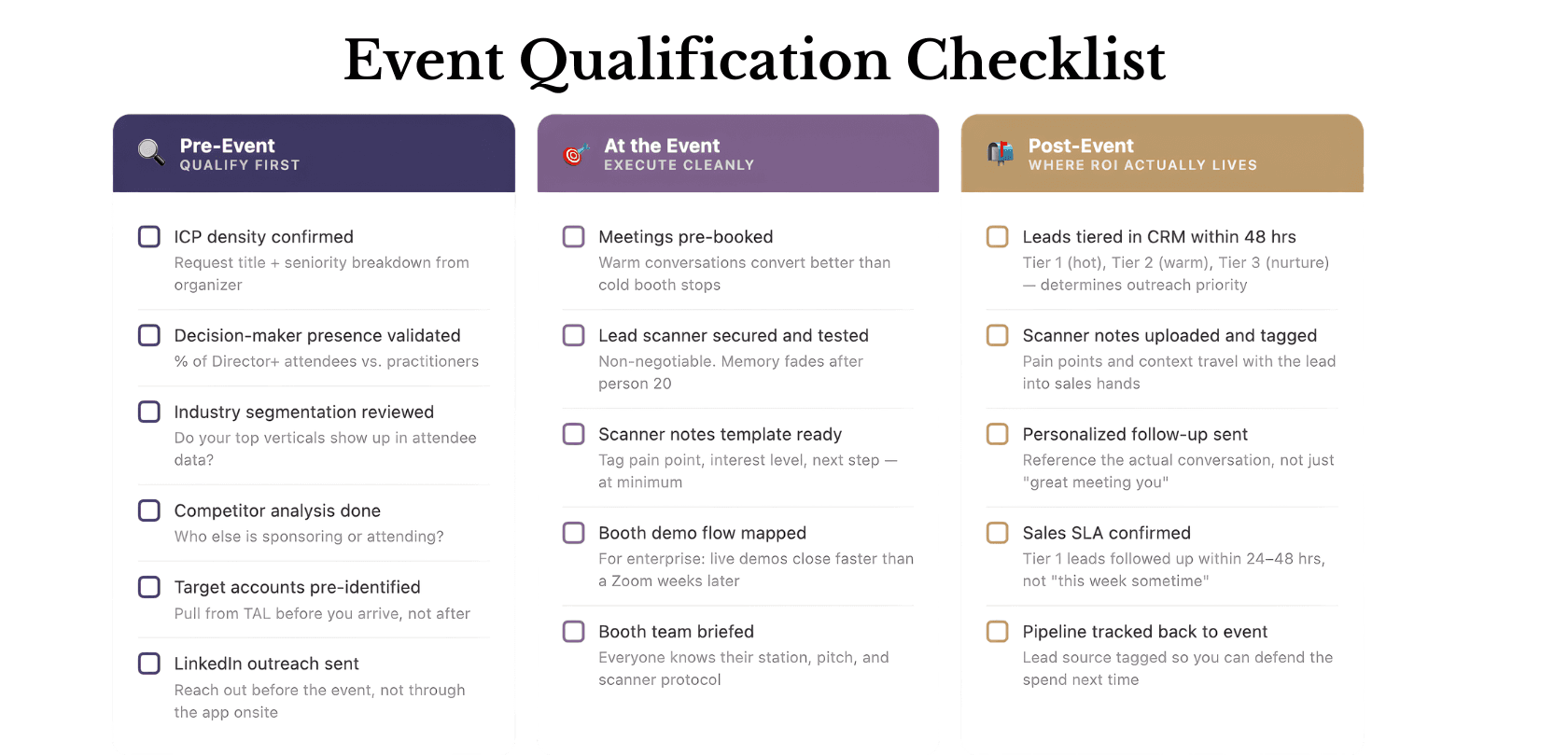
The event is the introduction. The follow-up is where revenue is made. Most teams invest in showing up. The ones who win invest equally in what happens after they leave.
➡️ Going
Arbitrary budget splits
Budget split formulas without context behind them are something I've been actively questioning.
"80/20 lead gen to awareness" sounds disciplined. But where did that number come from? And does it still reflect the market conditions you're operating in?
Budget allocation should reflect:
Company growth stage
Market saturation in your category
Pipeline health right now
Category maturity
If demand is weak at the top, you need to invest in awareness and education first. Channels that work well here: SEO, thought leadership content, research reports, PR, podcasts, organic social, newsletter placements, big industry events.
If traffic is strong but conversion lags, the issue is infrastructure and optimization — not more top-of-funnel spend.
If enterprise deals stall late-stage, ABM and executive activation are your levers — not more LinkedIn ads.
Channels should follow conditions, not just formulas someone passed down from a playbook written for a different company in a different market.
✖️ Gone
What I'm unlearning about how to evaluate whether something is working
The "kill it if it doesn't work in 30 days" reflex is one of the most expensive habits in B2B marketing.
I get why it happens: pressure is real, resources are limited, and patience runs thin when a campaign isn't showing the numbers people hoped for.
But the real problem is usually that kill criteria were never defined before launch. You can't evaluate a result against a standard that didn't exist when you started.
Define these before you spend anything. Pause or cut when:
Lead quality consistently misses ICP across multiple optimization cycles
You've run 3+ rounds of adjustments and engagement is still flat
There's been no pipeline influence over several quarters
The initiative no longer connects to a current strategic objective, meaning the company shifted direction and this channel didn't
Keep going when:
Engagement trends upward even if slowly
Sales references the content in calls (one of the strongest signals that it's working)
Pipeline velocity is improving — you're creating and closing faster than before
You're supporting a long buying cycle that structurally requires more time
The real risk isn't slow ROI. It's making the wrong call at the wrong time, cutting something that was about to compound, or defending something that should've been redirected six months ago.
🗽 Advice from a New Yorker
Each week, I ask someone in the city one question:
What’s one thing you’ve learned about building something?
This week, we hear from Ryan, Field & Pipeline Marketing Manager at Quantexa.
Where I’ve found the most success with in person events are not in trade shows with hundreds of sponsors and exhibitor booths, but in the mid size multi-day conferences that allow for deeper conversations/discussions.
When your outlook is on these medium sized conferences, all of your related marketing, sales, and partnership strategies are allowed more agency with less urgency— sales has direct tactical approaches in setting up meetings, there are more opportunities to build relationships with GSIs, and your marketing can handle more nuance when you’re not appealing en masse.
No detail is too small. Field marketing has one of the best opportunities to showcase what a company's brand looks and feels like outside of digital, and the details can really make or break a great introduction or meeting.
Field Marketing typically receives one of the largest budgets every fiscal year and has the most pressure to prove ROI. The teams that build something lasting are the ones investing in where conversations happen, obsessing over detail, and tracking it all through marketing influence models that append opportunities based on meetings and conversations held at the event.

To Ryan's point, the teams that build something lasting aren't focused on the biggest booths or the fastest returns. They're the ones who know exactly what they're building toward and are able to show it.
Closing thoughts
The fastest way to lose trust in a marketing conversation is setting the wrong expectations upfront, or having no expectations set at all.
Before your next investment, show the waterfall and put the timeline in writing:
0–3 months: Here are the signals we'll track (MQL quality, demo show rate, reply rate)
3–6 months: Here's when we expect to see pipeline influence (named account engagement, opportunity creation)
6–12+ months: Here's the compounding return (inbound lift, direct traffic, organic demand)
When the questions come — and trust, they will — you wont need to be on the defense. You're pointing to an agreement you made together.
That's how you build trust with those who control the budget.
Until next time,
Jaymi 🌆
Hey, it's Jaymi.
ROI has been on my mind as we close out Q1.
Return on investment is simple in theory: spend money, get more back.
But in B2B marketing, the investments are not small. They look like:
Paid media
Event sponsorships
Research reports
Intent data platforms
CRM systems and infrastructure
Attribution tools
Agencies and freelancers
Headcount
We can agree that the goal of any investment is to spend money to get more back. But when should we see that money come back? And how do you know something is working before revenue rolls in?
Two common misconceptions I've seen kill otherwise solid strategies:
Expecting short-term ROI from long-term investments
Expecting long-term payoff from short-term tactics (tactics are not the same as investments (I'll talk about this below)
The ROI conversation needs to happen before you spend, not after people start asking questions. If you're defining success mid-campaign, you're already behind.
🌱 Growing
ROI starts before you spend a dollar
Before you touch a single channel, you need to answer one question: what does marketing actually own?
Not "what campaigns are we running" > but what portion of revenue is our team responsible for influencing and/or driving directly? (Remember: marketing is increasingly becoming responsible for generating revenue, just like sales)
If you can't answer that, any ROI conversation becomes reactive rather than strategic. And being reactive is never really good.
Step 1: Start with company-wide goals
Companies typically define a few overarching goals a year. They look like:
Acquire X customers in a new vertical
Drive $X in new revenue
Improve efficiency metrics (cost per demo, CAC)
Step 2: Define annual marketing goals
Strong annual marketing goals look like:
Increase MQL to opportunity conversion rate by X%
Improve demo-to-opportunity rate by X%
Reduce cost per demo while increasing volume
Increase marketing-sourced pipeline by X%
Strategy explains why you're spending. Tactics explain how you get there.
Step 3: Define marketing tactics to help you get there
Tactics look like:
Run industry-targeted LinkedIn ads
Launch 2 webinars/quarter
Go to 3 intimate networking events (C-level only)
Publish more blogs around new content pillars explaining company POV
Launch 1 new experimental channel
Tactics belong at the bottom of the cascade, not the top.
Strategy explains why you're spending. Tactics explain how you get there.
Running paid media is not a goal.
The goal is: generate qualified pipeline that converts to revenue. Paid is just a lever.
If your KPI is revenue but you're measuring impressions, then you're misaligned.
Impressions are up? Great. But:
Are the right people clicking?
Are they the right titles?
Are they converting to SQLs?
Are they progressing pipeline stages?
Not all investments pay back at the same speed.
This is the piece that creates the most friction between marketing and leadership, and it's almost never discussed upfront.
I've been in those rooms when tensions rise because leadership isn't seeing the return they expect.
The solution isn't finding a faster-converting tactic. It's setting the right expectations from the start.
Here's how I see it:
0–3 Month Signal Investments
These generate early indicators, not revenue-generating right away:
Paid search
Paid social
Retargeting
Outbound tied to ICP lists
Direct mail tied to open opportunities
Smaller field events
These are ways you start to get in front of the buyer.
Signal ≠ revenue. Signals look like:
MQL quality improving
MQL to SQL velocity increasing (more marketing leads accepted by sales as "good leads")
Demo show rate lifting
Increased reply rates
Accelerated pipeline progress
You want to optimize these in real time.
If after 2–3 optimization cycles you're seeing bad-fit leads, flat engagement, and no pipeline impact then pause, diagnose, cut if necessary.
But don't confuse "it didn't convert in 30 days" with "this doesn't work." Those are different conclusions with very different consequences.
3–6 Month Investments
These are meant to build momentum, not immediate return:
ABM programs (targeting one or a few accounts with concentrated resources, as opposed to marketing to your entire total addressable market)
Intent-driven advertising and content syndication
Co-branded content partnerships
Webinar series
Strategic event sponsorships
These should show named account engagement, pipeline acceleration, and opportunity conversion lift in this window.
Look, expecting closed-won revenue in 30 days misunderstands B2B buying cycles entirely.
The average enterprise deal takes 3–9+ months to close. Multiple stakeholders are involved: decision-maker, champion, influencer...each with different questions, timelines, and levels of urgency. You're not convincing one person. You're building the case for a committee, which takes time and repeated exposure before anyone is ready to take a meeting, let alone sign.
Realistically, it takes the average buyer 8-14 touch points for them to convert (hence why attribution is so incredibly important). You rarely run an ad and see a prospect become a customer the very next day.
Your audience isn't cold, they're just not ready yet. "Not ready yet" looks the same as "this doesn't work" if you're not tracking the right signals letting you know you're on the track.
Long-Term Compounding Investments (6–12+ Months)
These build authority and organic demand over time:
Research reports
Evergreen educational content
SEO
Brand positioning
Partnership ecosystems
You may not close a deal in 30 days from content you wrote in January. But over time, you'll see:
Inbound demand increasing
Direct traffic growing (direct = high intent when someone searches for you specifically)
Sales referencing your content on calls — watch any marketer light up when a sales rep mentions this
These assets compound and reduce future acquisition costs because you're building a demand generation engine that runs in the background. That's the long game.
Note: Timelines shown are illustrative averages based on typical B2B buying cycles; actual results vary by industry, deal size, and sales cycle length.
The leadership conversation no one prepares you for
Early in my career, I worked with a founder who wanted to test newsletter sponsorships as a demand gen channel. The goal was to drive MQL volume with free trial offers.
What was expected to happen: quick conversions.
What actually happened: the audience wasn't warmed up enough to trust a free trial from a brand they'd seen once.
The instinct when that happens is to pull the investment. The smarter move is to look at what the data actually tells you.
After the first placement, we weren't converting. But we were building reach with the right titles in the right industries (always gauge the partner's audience to assess it's a good fit via demographic materials - don't partner if they can't provide this).
After the third and fourth placement, people who had now seen us multiple times started engaging — clicking through, requesting free trials, engaging with sales.
The tactic didn't fail. The timeline expectation was wrong.
What I've learned from rooms like that: if you don't define what "working" looks like before you spend, every conversation afterward becomes a defense instead of a data review.
Come in with a timeline framework: "in 0–3 months, here's what we should see. In 3–6 months, here's what we should see." That sets expectations and protects the investment from getting cut prematurely.
Intent data: where timing gets misunderstood
Intent platforms are expensive! Often mid-five figure annual investments. But there's a reason for this.
I spent time working at an intent data company serving enterprise clients and saw first-hand that when the data is accurate and your team can act on it fast, conversion rates are significantly higher.
The accounts that were in-market and received relevant, timely touch-points — matched to the exact topics they were already researching — converted much faster than generic outreach having no personalization. Speed and relevance matter more than volume.
Intent data allows you to:
Identify accounts actively researching relevant topics (you can track keywords around your business name, product category, competitor names)
Refine and prioritize your target account lists based on who's in-market now
Trigger personalized paid campaigns at the right moment
Support smarter, more timely sales outreach without seeming like you're blasting cold leads (sending relevant content, using the same keywords they were searching for)
The key word is timely.
Intent data is about right time, right place, right message. It tells you when an account is showing buying signals so you can act on their interest before it cools, without bombarding them with generic outreach that ignores what they've already told you through their behavior.
But intent data does not just work after you purchase it. It requires:
A defined monitored account universe
Clear intent thresholds (what signal level triggers action?)
CRM integration so sales can actually see and act on the data
A sales follow-up plan with defined SLAs
Without infrastructure, an intent-flagged lead can fall through the cracks entirely: a contact at a target account clicked a targeted ad, downloaded an ebook, and visited your pricing page....but sales has no idea any of it happened.
When structured correctly, you should expect pipeline lift in 3–6 months. Not 30 days.
If you're looking into intent data, make sure your team is operationally ready to use it.
Here's what that looks like.
Infrastructure: the hidden ROI driver
It may not be the sexiest topic on your mind, but it determines whether ROI is real or aspirational.
Infrastructure includes:
Account and lead source tagging (so you know where every lead came from)
Lifecycle stage tracking (so you know where every lead is in the funnel)
Demographic and firmographic enrichment
Proper lead scoring and routing rules
Defined sales SLAs for follow-up by tier
Sales enablement systems and assets that get used
On the flip side, broken infrastructure looks like: a contact at an intent-identified account clicks a targeted ad, downloads an ebook, and re-engages with your pricing page. But sales never gets flagged because the routing rule was never set up. The lead goes cold after a few weeks. The investment looks like it didn't work.
So, infrastructure doesn't generate demand. It prevents demand from leaking out the back.
Events: a different ROI equation entirely
My relationship with events runs deep from working at Worldwide Business Research, a company that organizes 20+ senior-level networking events a year, to being on the sponsoring and attending side in every B2B role since.
They can be your highest revenue driver or your most expensive branding exercise.
The difference is almost never what happens at the event. It's what happens before and after it.
Ways to participate:
Sponsor a booth
Buy a speaking slot
Host roundtables or invite-only networking events at the conference
Host a private dinner (entirely coordinated by your org, usually off-site)
Attend only, with scannable QR codes / badges other attendees can use to learn more
Before you commit budget, ask the organizer for:
Company breakdown of attendees (sometimes they'll show last year's full list, sometimes a sample of logos for the current year)
Job title and seniority breakdown
Industry and company size segmentation data
Past year attendance figures
Then reach out to target attendees before you get there — on LinkedIn, not just the conference app. The app feels transactional because everyone is doing it. LinkedIn feels organic because they've seen your profile and have context.
Before the event, prep your sales team properly. Give reps the conference floor plan, a breakdown of who's attending by title and company (plus highlight any current opportunities or clients on the list), any competitors showing up so they have differentiation points ready, and clear demo talking points.
At the event: lead scanners are non-negotiable. I repeat: non-negotiable.
You will talk to 50+ people in two days. By person 30, you will not remember what person 15 said, what their specific challenge was, or whether they asked for a follow-up.
A scanner with note fields solves that. Minimally, you want to capture: name, company, title, pain point mentioned, competitor they use (if applicable), interest level, and agreed-upon next step.
No scanner means no lead record. No lead record means no follow-up. No follow-up means you just paid sponsorship fees for a branding exercise.
For enterprise, booth demos are one of the most valuable things you can do.
When someone can see your product live with a subject matter expert right there to answer questions, that shortens the evaluation cycle significantly. Scheduling a demo three weeks later means competing with their calendar, their other priorities, and their fading memory of the conversation. That's a much harder close.
After the event is where your ROI lives. Most teams spend budget on just showing up. The ones who consistently win spend equal attention on what happens after they leave:
Tier your leads in the CRM within 48 hours: Tier 1 (ready now), Tier 2 (warm, 30-day follow-up), Tier 3 (longer-term nurture). Speed of follow-up by tier directly impacts conversion rate; the longer a warm lead sits un-contacted, the colder it gets
Upload scanner notes and tag them to the lead record — create a "Booth Notes - [Event Name]" field sales can see immediately when they pull up a contact in CRM
Follow up with something that references the conversation. Not "great meeting you at [event]!" but "you mentioned you were struggling with X - here's something that might be relevant."
The more specific your follow-up, the better it performs. Referencing what someone told you, by name, will always outperform a generic sequence
The event is the introduction. The follow-up is where revenue is made. Most teams invest in showing up. The ones who win invest equally in what happens after they leave.
➡️ Going
Arbitrary budget splits
Budget split formulas without context behind them are something I've been actively questioning.
"80/20 lead gen to awareness" sounds disciplined. But where did that number come from? And does it still reflect the market conditions you're operating in?
Budget allocation should reflect:
Company growth stage
Market saturation in your category
Pipeline health right now
Category maturity
If demand is weak at the top, you need to invest in awareness and education first. Channels that work well here: SEO, thought leadership content, research reports, PR, podcasts, organic social, newsletter placements, big industry events.
If traffic is strong but conversion lags, the issue is infrastructure and optimization — not more top-of-funnel spend.
If enterprise deals stall late-stage, ABM and executive activation are your levers — not more LinkedIn ads.
Channels should follow conditions, not just formulas someone passed down from a playbook written for a different company in a different market.
✖️ Gone
What I'm unlearning about how to evaluate whether something is working
The "kill it if it doesn't work in 30 days" reflex is one of the most expensive habits in B2B marketing.
I get why it happens: pressure is real, resources are limited, and patience runs thin when a campaign isn't showing the numbers people hoped for.
But the real problem is usually that kill criteria were never defined before launch. You can't evaluate a result against a standard that didn't exist when you started.
Define these before you spend anything. Pause or cut when:
Lead quality consistently misses ICP across multiple optimization cycles
You've run 3+ rounds of adjustments and engagement is still flat
There's been no pipeline influence over several quarters
The initiative no longer connects to a current strategic objective, meaning the company shifted direction and this channel didn't
Keep going when:
Engagement trends upward even if slowly
Sales references the content in calls (one of the strongest signals that it's working)
Pipeline velocity is improving — you're creating and closing faster than before
You're supporting a long buying cycle that structurally requires more time
The real risk isn't slow ROI. It's making the wrong call at the wrong time, cutting something that was about to compound, or defending something that should've been redirected six months ago.
🗽 Advice from a New Yorker
Each week, I ask someone in the city one question:
What’s one thing you’ve learned about building something?
This week, we hear from Ryan, Field & Pipeline Marketing Manager at Quantexa.
Where I’ve found the most success with in person events are not in trade shows with hundreds of sponsors and exhibitor booths, but in the mid size multi-day conferences that allow for deeper conversations/discussions.
When your outlook is on these medium sized conferences, all of your related marketing, sales, and partnership strategies are allowed more agency with less urgency— sales has direct tactical approaches in setting up meetings, there are more opportunities to build relationships with GSIs, and your marketing can handle more nuance when you’re not appealing en masse.
No detail is too small. Field marketing has one of the best opportunities to showcase what a company's brand looks and feels like outside of digital, and the details can really make or break a great introduction or meeting.
Field Marketing typically receives one of the largest budgets every fiscal year and has the most pressure to prove ROI. The teams that build something lasting are the ones investing in where conversations happen, obsessing over detail, and tracking it all through marketing influence models that append opportunities based on meetings and conversations held at the event.
To Ryan's point, the teams that build something lasting aren't focused on the biggest booths or the fastest returns. They're the ones who know exactly what they're building toward and are able to show it.
Closing thoughts
The fastest way to lose trust in a marketing conversation is setting the wrong expectations upfront, or having no expectations set at all.
Before your next investment, show the waterfall and put the timeline in writing:
0–3 months: Here are the signals we'll track (MQL quality, demo show rate, reply rate)
3–6 months: Here's when we expect to see pipeline influence (named account engagement, opportunity creation)
6–12+ months: Here's the compounding return (inbound lift, direct traffic, organic demand)
When the questions come — and trust, they will — you wont need to be on the defense. You're pointing to an agreement you made together.
That's how you build trust with those who control the budget.
Until next time,
Jaymi 🌆