2026
Client
Rafias (UPenn-Affiliated)
Industry
Biotech
Service(s)
Website Strategy & Brand Positioning
Goal
Generate Investor Inquiries to Support Funding

Project Overview
Rafias is an early-stage neuroscience biotech originating from the University of Pennsylvania's Heller Lab, developing the first-ever medication designed to prevent relapse in stimulant use disorder, a condition with no FDA-approved treatments.
The project involved building their website from scratch and designing a full narrative system to translate complex addiction science into clear, credible communication for biotech investors, NIH reviewers, and academic collaborators.
This time, the goal wasn't traffic. It was to reach a small, senior audience with an unprecedented solution and give them exactly what they needed to act, driving direct funding inquiries.
Challenge
Scientific Translation
Content Strategy
Brand Buildout
Visual Communication
Being an early-stage biotech, translating rigorous academic science into investor-ready communication was the core challenge.
If messaging is too technical, investors disengage. If it's too simplified, credibility comes into question. The work required finding the balance with language that was precise enough to satisfy NIH reviewers and domain-informed investors, while remaining legible to a non-scientist evaluating a first-of-its-kind opportunity in under ten seconds.
Next, Rafias had no existing branding. Color system, typography, and visual identity were built from scratch, with the constraint that everything needed to feel credible alongside a major research university affiliation without being derivative of it.
The science also had to work visually. Development path, mechanism of action, and funding milestones all needed formats investors could scan in seconds, designed and iterated inside a platform not built for complex scientific UX.

Approach
Website From Scratch
Messaging Framework
Investor Narrative
Narrative System Design
Before any page was written, the core narrative logic was mapped: what investors needed to believe, in what order, to move from curiosity to inquiry. The story was built around a central insight, addiction as a neuroadaptation problem not a behavioral one, and the company's unique position targeting Nr4a1, a transcription factor that governs the brain's ability to reset. That framing became the spine of every page.
Website Architecture
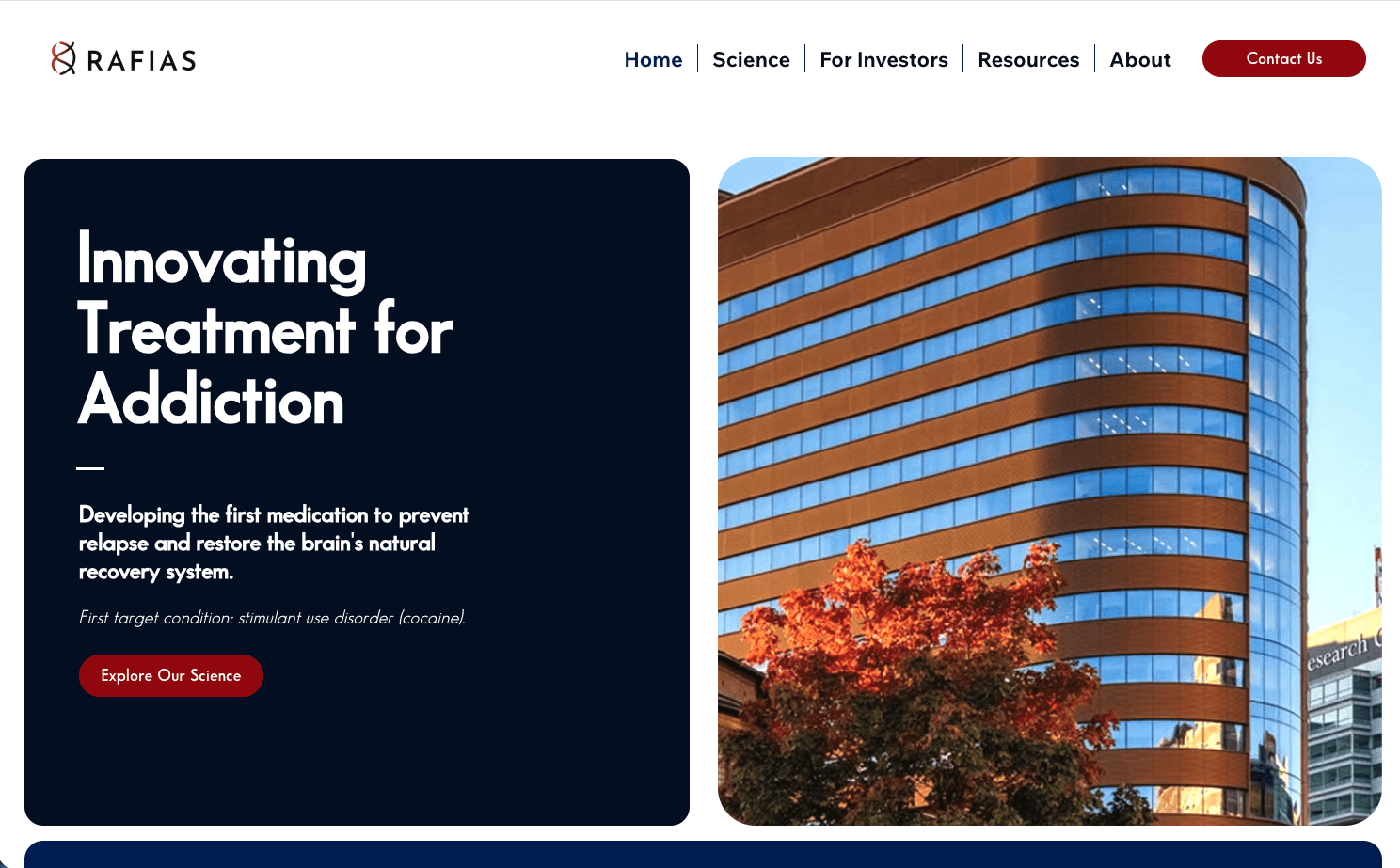
The following core pages were designed and built: Home, Science, For Investors, Resources, About, Contact. Each mirrors the investor decision process. The homepage establishes credibility immediately. The Science page carries the intellectual weight through mechanism, timeline, and translational pathway. The For Investors page frames commercial opportunity. The Resources page provides validation through publications and NIH proof points without overwhelming the reader. An About page and individual team bio pages were built to surface the depth of the founding team, with each profile written to reinforce scientific credibility. The contact page was designed as the conversion endpoint, with a structured inquiry form routing directly to the team.
Brand & Visual Identity
The full visual identity was created from scratch, including color system, typography, and design language. The palette anchored on deep navy and scientific blue with a red accent, credible alongside a Penn affiliation without mimicking it. Milestone timelines, mechanism diagrams, and publication blocks were designed to make complex information scannable.
Scientific Messaging Translation
The science was translated without being stripped. Concepts like neural homeostasis, relapse prevention, and transcription factor targeting were explained in plain language but with enough structural precision to signal rigor. The goal was confidence transfer: a reader without a neuroscience background should finish a page feeling informed, not lost.
Investor and NIH Alignment
The messaging was calibrated for two distinct but overlapping audiences: biotech investors evaluating commercial potential and NIH reviewers evaluating scientific validity. The translational roadmap, from target discovery through preclinical work toward IND filing, was structured to speak to both without compromising either.

Outcome
High Organic Discoverability
Strong Engagement Quality
Investor Readiness
Foundation Built
Rafias launched with a website built for a specific job: attract a small, qualified audience and give them enough to act. Early performance reflects exactly that.
Within the first 30 days, the site drew 134 unique visitors and 251 sessions, driven entirely by organic discovery and direct outreach with no paid support. Average session duration came in at 3:55, outperforming 92% of comparable sites, a strong signal that visitors are diving into the content. 33% of traffic arrived via organic search, indicating the content structure and scientific language are already indexing effectively.
For an early-stage biotech targeting a narrow investor audience, depth of engagement matters more than volume. The site is reaching the right people, holding their attention, and giving them a credible, structured case for the science.
Elizabeth Heller, Founder, Rafias